Painting History
John Trumbull tried capturing the essence of the new nation
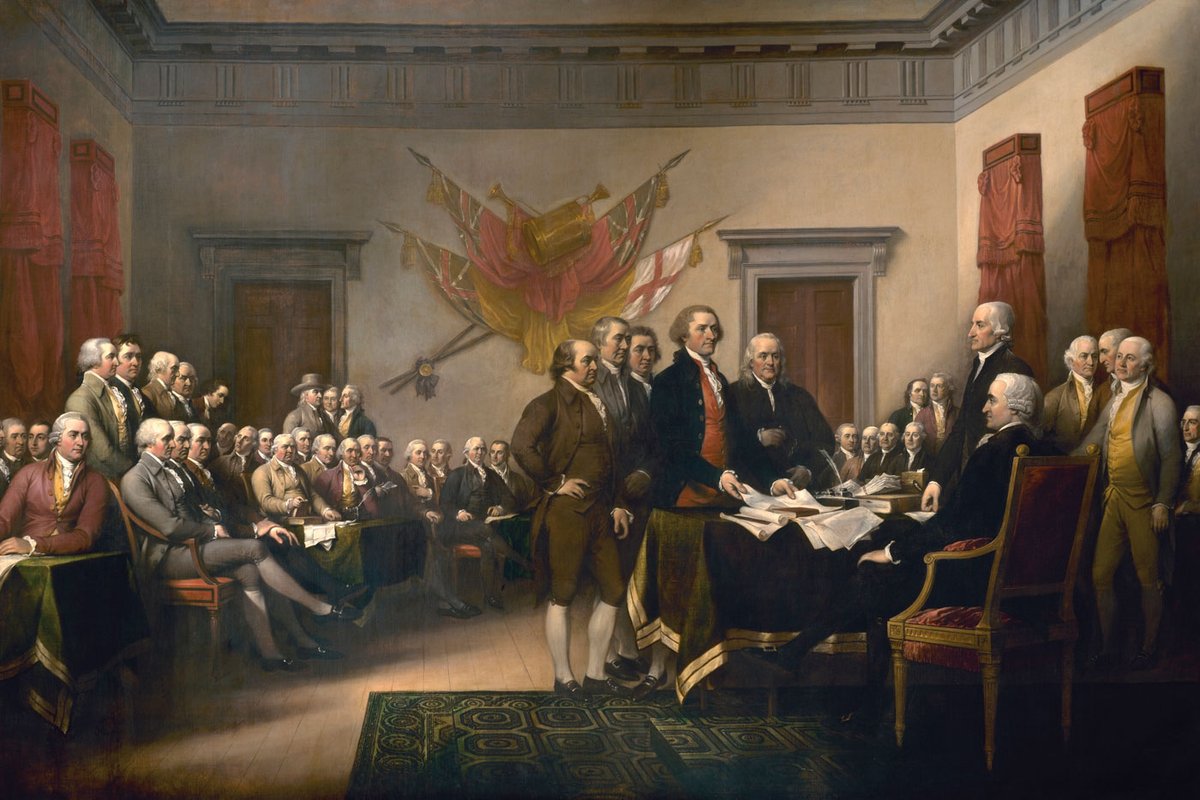
John Trumbull’s magisterial painting Declaration of Independence was hung in the rotunda of the Capitol in November 1826. The declaration itself was 50 years and 4 months old when the painting was installed. Trumbull had worked on it for almost as long — 40 years — a process that involved Thomas Jefferson, the document’s draftsman.
The Artist As a Young Man
John Trumbull was born in 1756 in Lebanon, Connecticut. He wanted to be an artist from his boyhood. His older sisters, Faith and Mary, were taught painting and embroidery, like other young ladies in 18th-century England and its colonies. In his memoirs Trumbull recalled his youthful efforts to copy their work: “For several years the nicely sanded floors” of the family parlor “were constantly scrawled with my rude attempts at drawing.”
Trumbull was 15 when he first met a real painter. He had been sent to Harvard, his father’s alma mater, and nearby Boston was the home of John Singleton Copley. The painter had won a transatlantic reputation with his portraits of wealthy merchants and their families. Copley’s canvases showed three-dimensional spaces, realistically lit, in which the fabrics of the sitters’ outfits were so carefully rendered one could almost stroke them. Trumbull was dazzled: Copley’s paintings “riveted, absorbed my attention.”
Trumbull’s father was not dazzled. Jonathan Trumbull Sr. had been governor of Connecticut since 1769. He wanted his son to take up some practical profession, business or the law. John argued that, like the artists of ancient Athens, as a painter he could honor his homeland and be honored by it. Jonathan Sr. answered with a crushing one-liner — “Connecticut is not Athens.”
The Revolutionary War Years
Family disagreements soon paled beside the outbreak of the American Revolution. After the battles of Lexington and Concord in April 1775, Gov. Trumbull declared that Connecticut would defend its rights “to the last extremity.”
John joined the Continental army, rising to the rank of colonel. He served in New England and New York, on the fringe of the Battle of Bunker Hill, and in the thick of the Battle of Quaker Hill outside Newport, Rhode Island. He was shot at and saw men killed and dismembered.
Thanks to his abilities and his father’s connections, he served on the staffs of Gen. George Washington and Horatio Gates. He also met Benjamin Franklin, John Adams, the Marquis de Lafayette and John Hancock. What Trumbull called the “moral storm” of the Revolution plunged him into politics and war.
He never lost his artistic vocation, however. Copley, a loyalist, had moved to England, leaving no one in America who could inspire or teach him. If Trumbull wanted to progress as a painter, he would have to go to England too.
Trumbull’s Tutelage
Late 18th-century London had an Academy of the Arts sponsored by King George III and several excellent painters, including Benjamin West. The Pennsylvania-born West moved to London in 1763 and was the king’s official history painter. Still, he always remained hospitable to aspiring Americans and in the early 1780s accepted Trumbull as one of his students.
West’s most famous canvas, The Death of General Wolfe, had inaugurated a revolution in painting historical scenes. In it, West depicts British Gen. James Wolfe dying on the field at the moment of victory, surrounded by grieving officers.
Contemporary art critics argued that painters should show historical figures, even modern ones, in plain classical garb so as not to distract from the nobility of their deeds. West went in the other direction, presenting his subjects in the uniforms they actually wore as colorful and detailed as he could paint them. West’s realism drew viewers in, putting them there, where history was being made.
A Revolutionary Resolve
Trumbull absorbed the lesson and pushed it farther. He was determined to paint, not a single scene, but a series of pictures that would tell the story of the American Revolution.
Over the fall, winter and spring of 1785-86, he painted two scenes, The Death of General Warren at the Battle of Bunker’s Hill, June 17, 1775 and The Death of General Montgomery in the Attack on Quebec, December 31, 1775. They are blockbusters, full of movement, drama and death.
Abigail Adams, who saw the Bunker Hill painting when her husband was minister to Great Britain, wrote that “in looking at it my whole frame contracted, my Blood Shiverd and I felt a faintness at my Heart.”
Now his project took a different turn, thanks to an invitation from Thomas Jefferson.
A Jeffersonian Idea
Born in 1743, Jefferson had served Virginia as congressman and governor. His most striking performances had been rhetorical: a 1774 tract, A Summary View of the Rights of British North America, and the Declaration of Independence. Jefferson had a gift for packing enormous implications into clear phrases, both musical and compact. He was simultaneously a philosopher and an artist.
Jefferson embraced the visual arts as well. He had already begun work on his mountaintop aerie, Monticello. Sent by Congress to France in 1784, he would study Roman ruins in Provence. He met Trumbull on a side trip to London. Always on the lookout for younger protégés, Jefferson found in the man from Connecticut a patriot and an artist.
Jefferson invited Trumbull to stay with him in Paris. Trumbull, eager to see the artworks and artists there, agreed, arriving at Jefferson’s rented mansion in the Chaillot neighborhood in the summer of 1786.
Jefferson suggested that Trumbull’s next subject in his Revolutionary series be political — an image of the Continental Congress and the Declaration of Independence. It would mark the moment of independence and show the representatives of the American people who had made it happen (including, prominently, Jefferson himself).
We don’t know what Jefferson and Trumbull said to each other as they discussed the painting, but we have what they drew for each other. On a sheet of paper, now held at the Yale University Art Gallery, Jefferson sketched a floor plan of the room in the Pennsylvania State House where Congress had approved and signed the document. Below Jefferson’s sketch Trumbull drew his first outline of the scene — faceless figures representing the drafting committee, the president of Congress receiving their handiwork, and other congressmen arrayed on either side of them.
Setting the Scene
The painting Trumbull finished hangs, with its companions in his Revolutionary series, at Yale. It is small — 2 feet tall by 3 feet wide. In the foreground slightly right of center stand the members of the drafting committee: Adams; Roger Sherman; Robert Livingston; Jefferson, who holds the declaration; and Franklin. Hancock, president of Congress, sits at his desk, angled toward them so that viewers of the painting are not looking at his back. The other members of Congress sit and stand. A few are talking to each other, but the great majority are, like the viewer, paying attention to the occasion.
Trumbull does not show any of the words on Jefferson’s paper. But the painting imparts important things about the nation these men were creating. Although there is a war going on — battle trophies hang on the wall behind them — everyone is in civilian clothes. This will not be a military state.
Many of the signers were wealthy — when Charles Carroll of Maryland affixed his name, someone is said to have joked, “There go a few millions” — but none were noble. Royalty and aristocracy have been jettisoned. All of the men are calm. No one declaims or poses. They are pledging their lives, fortunes and sacred honor, and they are doing it deliberately.
Trumbull labored to get the faces right. He painted Adams and Jefferson in Europe, and then, after returning to the United States in 1789, he traveled the East Coast collecting likenesses. If a signer had died, he copied an existing picture or painted a son. By 1793, he had finished his Declaration and worked on four more Revolutionary scenes — two battles (Trenton, Princeton) and two British surrenders (Saratoga, Yorktown).
A Pause in Painting
Then came a halt — a long one. Trumbull hoped the new federal government would pay him to complete his project, but it had other financial priorities. He tried offering a subscription for the purchase of engraved prints — a common way artists then monetized their work — but that fizzled.
Current events — the beginnings of the French Revolution and of the first American two-party system — made the American Revolution old news. One of the casualties of American politicking was Trumbull’s friendship with Jefferson. Trumbull became a Federalist, the party of those who supported President Washington’s domestic and foreign agendas. Jefferson, even though he served as Washington’s secretary of state, became the leader of the opposition Republicans. It got personal: At one dinner Trumbull saw Jefferson “smiling and nodding” as a young Virginia Republican assailed him and his Yankee forebears.
Trumbull abandoned painting for
six years. He tried his hand at business and at diplomacy. When he took up his brush again in 1800, he supported himself by painting portraits, in both England and America.
Back to the Canvas
America and England went to war once more in June 1812. The peace that came two and a half years later restored the status quo ante, although America did have to rebuild much of Washington. After two decades of distraction, Trumbull saw an opportunity to complete his long-neglected series.
The prewar Capitol had consisted of two wings joined by a walkway. When rebuilt, the wings would be linked by a domed rotunda. Trumbull applied to decorate it. Friends in Congress lobbied for him, and he turned for additional support to two of his subjects, former Presidents Adams and Jefferson. Adams, now in his 80s, wrote a feisty letter full of praise, but no help. But his long-lost friend Jefferson came through.
Trumbull’s reaching out touched a chord in the Virginian’s memory. “We learn, as we grow old,” Jefferson wrote, “to value early friendships, because the new-made do not fit us so closely.” Then he got down to business, graciously. Trumbull thought he needed Jefferson’s backing. “No, my dear Sir, your own reputation, your talent known to all, is a patronage with all.”
Jefferson nevertheless added his own recommendation, writing Virginia Sen. James Barbour that he could “bear witness of my own knowledge to [Trumbull’s] high degree of worth as a man. For his merit as a painter I can quote higher authorities, and assure you that on the continent of Europe, when I was there, he was considered as superior to West.”
Congress commissioned Trumbull to paint four canvases, each 12 feet by 18 feet. (Anything smaller would have been swallowed in the immensity of the rotunda.) He finished the new Declaration first, in September 1818, and exhibited it throughout the northeast. Adams saw it when it was shown in Boston; Jefferson, though, at Monticello never got the chance. It was joined in the rotunda by Trumbull’s surrenders at Saratoga and Yorktown and by a new composition showing Washington returning his commission as commander in chief to Congress at war’s end in December 1783.
Critics then and since have slighted the rotunda paintings, for Trumbull by his 60s had lost his finer skills: His drawing is blocky, his coloring dulled. But he never lost his sense of design and narrative, and that is what comes through in large works displayed in vast public spaces.
The men who make history die, like all men. Adams and Jefferson passed together on the July 4, 1826 (Trumbull lingered until 1843). If we want to meet them, we must turn to history, which exists mostly in words — their own, and those of historians. But art can tell the story too.
John Trumbull, with Jefferson’s help, captured one of Jefferson’s, and America’s, greatest creations, and Trumbull’s own creation hangs in the Capitol for all to see.
More from this Issue