Stone’s Declaration
William Stone Created the Image Most Americans Know
After adopting the Declaration of Independence on July 4, 1776, the Continental Congress directed John Dunlap, its official printer, to set the words to type. Copies were then sent to every state as well as to the commanders of the Continental troops. Congress also ordered that the declaration be engrossed, which means formally written by hand. The person who copied the famous words was probably Timothy Matlack, an assistant to the secretary of the Congress, who was known for his penmanship. It is this engrossed copy that 56 delegates to Congress signed.
An earlier draft of the declaration in Thomas Jefferson’s hand still exists. It has been preserved at the Library of Congress.
Over the years, the unrolling and rerolling of the engrossed copy took a toll on the document. By 1817, Richard Rush, who was the acting secretary of state, referred to those effects as the “hand of time.”
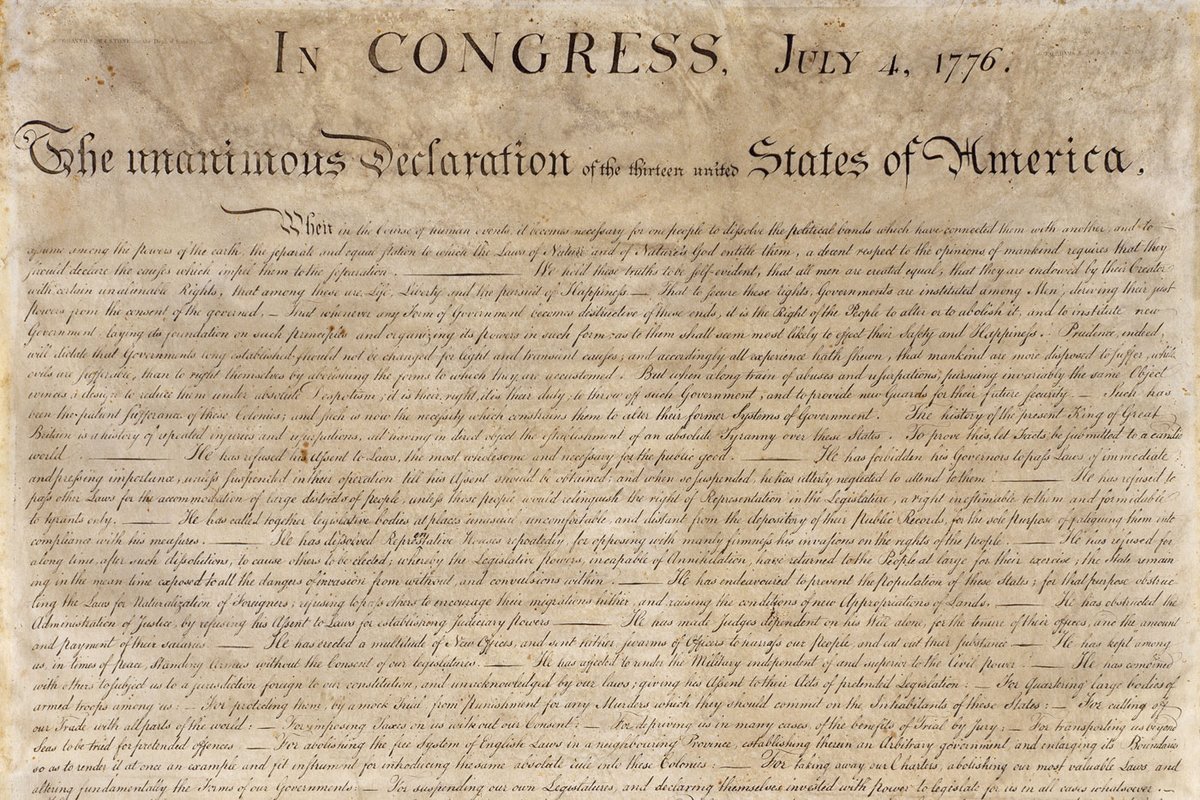
Three years later and aware of the damage done, Secretary of State John Quincy Adams commissioned engraver William J. Stone to create an exact copy of the engrossed declaration. Stone meticulously copied the original onto a copperplate, which he completed in 1823. The State Department used that copper printing plate, to print 200 copies on vellum. Those prints were considered official copies for government use and were sent to each of the still-living signers: Thomas Jefferson, John Adams and Charles Carroll of Maryland. Copies were also sent to former President James Madison, as well as various officials, branches and departments of the government. Governors of each state and territory also received copies, as did some colleges and universities and the Marquis de Lafayette.
About 50 parchment printings of Stone’s Declaration of Independence still exist, one of which belongs to Colonial Williamsburg. Some paper copies also still exist, probably proofs that Stone printed. The Stone copperplate is held by the National Archives in Washington.
The original engrossed copy was further damaged because of extensive exposure to light when it hung on a wall near a window from 1841 to 1876. Stone’s image is the one most Americans know, rather than the now largely illegible original.
“We are thrilled to have this important piece of American history in our collection and to be able to share it with our guests as we celebrate the 250th anniversary of the declaration and our nation’s founding,” said Doug Mayo, associate librarian at Colonial Williamsburg’s John D. Rockefeller Jr. Library. “We hope it will encourage people to reflect upon the ideals of the founding generation and the nation those ideals created.”
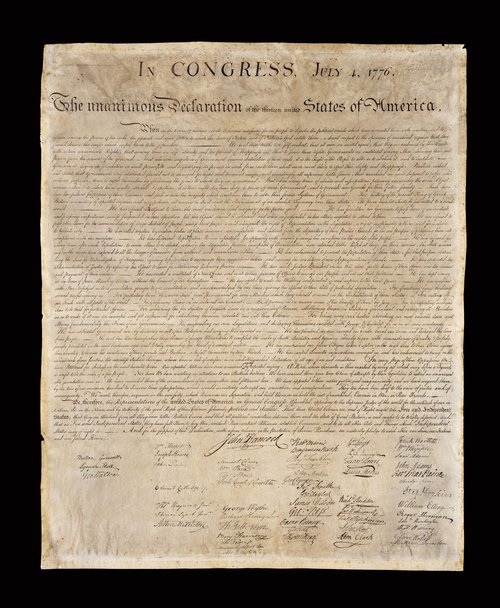
Declaration of Independence
MAKER William Stone
DATE 1823
DIMENSIONS 31¹⁄₂ inches x
26³⁄₈ inches
PLACE Washington
MEDIUM Parchment, printed from a copperplate
More from this Issue