The Devil Is in the Dovetails
Uncovering Williamsburg’s first cabinetmaker
On Jan. 26, 1776, The Virginia Gazette reported on a fire on Duke of Gloucester Street: “Mr. Peter Scott’s old house in this city, which he had rented and lived in for 43 years, was burnt down last Sunday night, by accident.”
Scott, a successful cabinetmaker, had died in November of the previous year, but the newspaper’s editor knew that Williamsburg residents would still associate the property with its former, long-standing tenant. Readers today would be more familiar with Scott’s final landlord, George Washington. In fact, it was soldiers serving under Washington as commander in chief of the Continental army who inadvertently sparked the blaze.
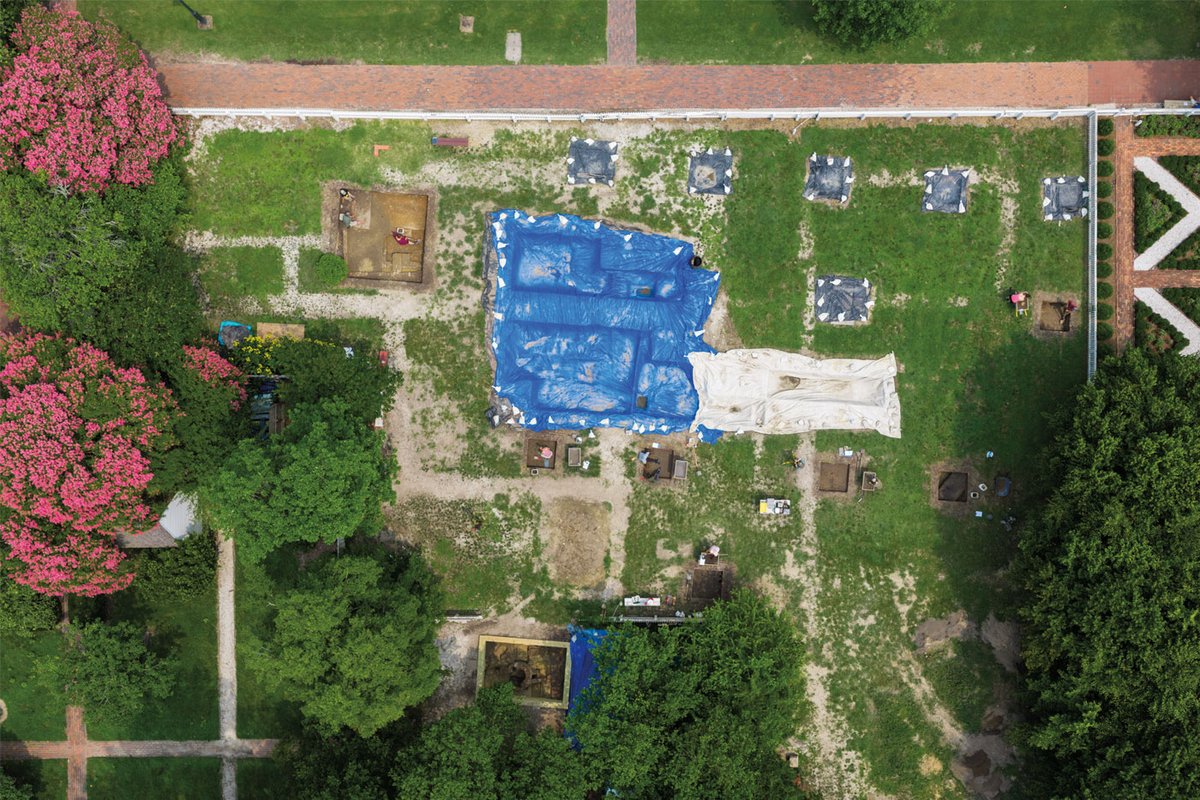
Now, 250 years after the fire destroyed the property, The Colonial Williamsburg Foundation is unearthing the site to further investigate the archaeological remains. Portions of the site were previously surveyed and excavated in 1955 and 1958 under architectural draftsman James M. Knight and Ivor Noel Hume, who was the first director of archaeology at Colonial Williamsburg. The results of those earlier digs helped inform the plan for the current excavations.
“Returning to one of the Foundation’s early archaeology projects with new techniques and new research questions is a full-circle moment,” said Jack Gary, vice president of archaeology and historic landscapes.
One goal of the project is to ascertain if and how Scott used the site for his cabinetmaking business as well as his home. Such archaeological research into a prominent artisan can also lead to new insights about daily life, style and furniture production in the 18th century. Further, the excavations are informing whether the Foundation will reconstruct any of the structures on the site and what they would look like.
First Williamsburg Cabinetmaker
Born in Scotland, Scott arrived in Williamsburg by 1722. Here, he established himself as the first and longest-serving cabinetmaker in the colonial capital, producing high-quality tables and case furniture for more than 50 years.
“That’s a pretty remarkable run for that time in our history,” said Ron Hurst, Colonial Williamsburg’s chief mission officer, who has been studying Scott for the past 30 years. “He is making furniture for people with enormous resources and big names: Robert Carter, Thomas Jefferson and others.”
Although records indicate that Scott owned property on a backstreet in town, he began renting the Duke of Gloucester Street house in 1733. Directly across from Bruton Parish Church, it was owned by John Custis IV. Over time, Scott’s landlords changed, first from Custis to his son Daniel Parke Custis; to his son’s widow, Martha Dandridge Custis; and ultimately to George Washington, who took ownership following his marriage to Martha.
Washington’s careful recordkeeping helped Hurst to identify a dressing table at George Washington’s Mount Vernon as one of two such pieces that Scott made for Daniel Parke Custis in 1754 in exchange for two years of rent. A third dressing table, virtually identical, that has also been attributed to Scott is on view in the Art Museums of Colonial Williamsburg.
“The details of furniture construction are not unlike handwriting,” Hurst said. “Everybody does it differently. So by looking at construction details — the dovetails, the way the drawers are put together, foot blocking, all those things — and then seeing exactly the same pattern of construction details in other things that have local ownership histories, suddenly you can start to build a whole body of material that you can say, ‘These things are all from this one shop.’”
Exposing the Story of the Site
While finished furniture pieces tell their own story, the team working at the site, which most recently hosted the Colonial Garden, is learning more about how the property was used during the 18th century. Guests have been able to watch the work as it has progressed and speak with the archaeologists and volunteers about their discoveries.
The work has focused on understanding the main house, potential workshop and outbuildings that once stood on the lot. Noël Hume partially excavated the tenement building’s foundation but left some of it intact. The current investigations have resulted in an outline of the full footprint of the brick foundations of both the house and a detached kitchen. Evidence that speaks to how Scott may have organized a cabinetmaking shop is also coming out of the ground.
“In the middle of the kitchen footprint is a masonry structure that appears to be a kiln built into the floor and tied into the kitchen chimney. While research is ongoing, one as yet unproven theory is that it was for drying wood, which would be the only such one we know of in 18th-century Virginia,” Hurst said.
Recovered artifacts including tools, furniture tacks and a broken drawer handle further suggest that cabinetmaking work was being performed at the site, whether by Scott himself or by free or enslaved workers. Wood fragments and mortar samples have also been collected for future testing to learn more about the building’s foundations.
To Reconstruct or Not to Reconstruct
John Custis IV acquired three adjacent lots opposite Bruton Parish Church in 1714. Landowners were required by law to build within two years or lose possession of the property. Thus, construction of the tenement houses he erected on the lots must have begun by 1717.
Many buildings from that early in the 18th century had leaded casement windows and riven clapboard roofs. The wooden sash windows and shingle roofs more commonly seen throughout the Historic Area came into style later in the century. Reconstructing the house Scott rented would give the Foundation the opportunity to showcase that evolution of architectural styles in 18th-century Williamsburg.
For now, the focus is on completing the investigation and documenting the site. Fieldwork is expected to continue through the end of 2026 and possibly into the beginning of 2027, depending on available funding. Donor support of this project will ensure archaeologists have the necessary tools to do the work well and continue their research in the lab through artifact analysis, curation and scientific testing.
“I think the ability to recapture a very prominent 18th-century Williamsburg citizen, and his environment, is a really important thing to do,” Hurst said. “And over the course of the last 40 years, we’ve really shifted our interpretation to broadly encompass the whole cross-section of society. Lots of great historic sites generally focus on one individual or one family. Here we have this amazing, complicated mosaic of society in 18th-century America, and we can talk about all of it.”
How You Can Help
Donor support advances Colonial Williamsburg’s mission to explore and interpret our nation’s history and its origin story. By investigating and reconstructing the Peter Scott site, we can better understand the impact Scott, his work and the broader site had on the community. To contribute, visit colonialwilliamsburg.org/TT. For more information on how to support the Peter Scott project, email campaign@cwf.org.
More from this Issue