“Emblem of the Revolution”
The hunt for hunting shirts leads to Germany
In the mid-18th-century backcountry of colonial America, the hunting shirt was born out of necessity. Simple in construction — typically linen, cut from squares and rectangles, split down the center front, with a cape around the neck and fringed edges — this garment was the workaday dress of frontier life, worn by the men who hunted deer to meet the colonists’ demand for leather breeches. Few fashions were more purely American.
By the eve of the Revolution, the hunting shirt had taken on new meaning. On June 1, 1775, as Lord Dunmore, the royal governor of Virginia, convened a hastily called assembly session, rebellious members of the House of Burgesses arrived wearing hunting shirts as a pointed, wordless act of defiance. Within weeks, hunting shirts would also be worn by the soldiers of the Continental army.
The Shirts Go to War
On June 14, 1775, the Continental Congress authorized six companies of backcountry riflemen from Pennsylvania, Maryland and Virginia to march to Boston, where George Washington had just taken command of an army of some 20,000 men in desperate need of support as well as new clothing. The backwoodsmen made the nearly 500-mile march in just 25 days, and with them came the hunting shirt.
Washington was familiar with the garment and was a fan. Practical, cheap and quick to produce, the shirt also carried an almost mythological power on the battlefield. “It is a dress justly supposed to carry no small terror to the enemy,” Washington wrote, “who think every such person a complete marksman.”
He ordered no fewer than 10,000 hunting shirts, began acquiring large quantities of linen, circulated patterns and promoted the shirts as a means of building esprit de corps among his ragged troops. While Congress in Philadelphia struggled to outfit the army in proper woolen coats, the hunting shirt became the essential stopgap. Most Continental soldiers and officers likely wore one at some point during the war.
Tens of thousands of hunting shirts were made. Yet when the war ended, the once-prolific shirts were worn out and largely discarded in the dustbin of history.
A Vanishing Emblem
In 1833, George Washington Parke Custis, Washington’s adopted grandson, was already mourning the shirt’s disappearance. “The Hunting Shirt, the emblem of the Revolution, is banished from the national military,” he wrote, predicting it would one day be found only “in museums, like ancient armour, exposed to the gaze of the curious.”
Custis was more right than he knew. Only three Revolution-era hunting shirts were known to have survived, and just one was confirmed as battle worn: Capt. Abraham Duryea of the Dutchess County militia wore his hunting shirt during the battle of Long Island, New York, in 1776. Donated to the now-defunct Tomlinson Museum in Poughkeepsie, New York, in 1855, the shirt eventually made its way to Washington’s Headquarters State Historic Site in Newburgh, New York, where it remains on view today.
Three shirts were the entire material record of one of the Revolution’s most widely produced garments. That is, until now.
A Discovery in Germany
In early 2025, two colleagues researching European collections stumbled onto something remarkable: two hunting shirts, in two separate German museums, neither previously known to scholars. With a grant from the Mary and Donald Gonzales Field Experience Fund, which supports continuing education opportunities directly related to an employee’s job and the educational mission of Colonial Williamsburg, I traveled to Brunswick and Mannheim, Germany, in November 2025 to document and pattern the shirts firsthand.
The city of Brunswick had deep ties to the American Revolution. In 1776, Britain’s King George III asked Charles William Ferdinand, Duke of Brunswick-Wolfenbüttel, to send troops to help suppress the colonial rebellion. By war’s end, more than 5,000 Brunswick soldiers had crossed the Atlantic, and most never returned to their homeland, instead settling in the new United States.
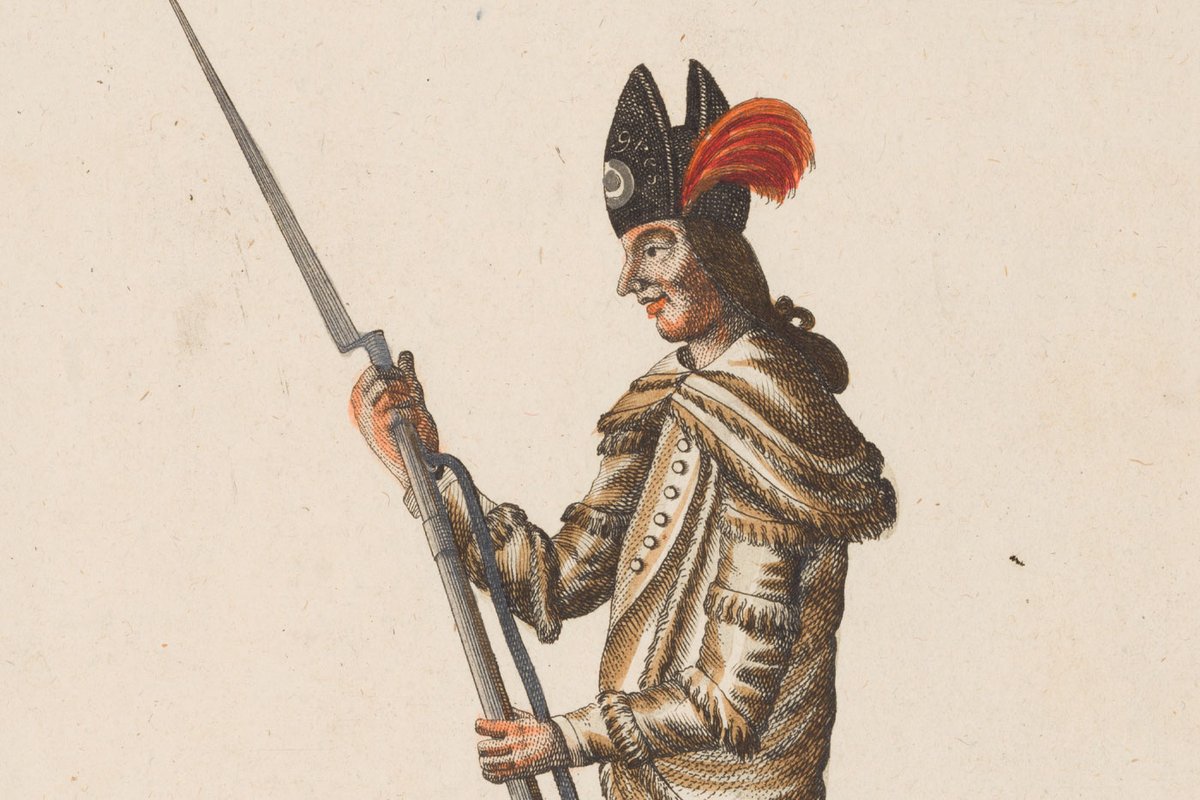
However, one of those soldiers brought something back home. Capt. Johann Conrad Ruff collected a hunting shirt and cap between 1777 and 1779. A letter from a Brunswick court councillor named Hoefer confirms they were presented to the duke “so that His Highness may graciously see what kind of clothing the highest officers currently wear in America.” The cap is now lost, but the shirt survives in remarkable condition in the city’s municipal museum. Like the Duryea shirt, it is made from linen, split down the center front with a distinctive zigzagging fringe pattern along the center and hem, with a caped collar trimmed in decorative tufts. The lower sleeves are pleated to control the fullness and to ensure they do not get in the way of the wearer. It is now the second hunting shirt with a confirmed history of being worn during the Revolutionary War.
The Reiss Engelhorn Museum in Mannheim holds the other newly discovered shirt. Museum records first mention it in the 1880s, with no documentation of where it came from. But based on its placement in the oldest portion of the
collection, it may have belonged to the collection of Carl Theodor, a high-ranking Bavarian nobleman. As with the Brunswick shirt, its novelty as a distinctly
non-European garment and possible military uniform likely made it a prized souvenir.
A few things, however, set the Mannheim shirt apart from the other four: its large size — over 40 inches long with a 70-inch chest and 20-inch neck — which made practical sense for frontier soldiers who used the generous front fold as a makeshift saddlebag for food, tow cloth for wiping the barrel of a rifle and other supplies; shirt sleeves terminating in fringes, like a ruffle; and only fringe around the cape. Perhaps most strikingly, it is the first surviving example of a dyed hunting shirt, previously known only from written descriptions.
Why It Matters
The discovery of two additional hunting shirts — now bringing the known total to five — is more than a footnote in textile history. The uniform of the Revolutionary War for some soldiers, this garment was a symbol of American ingenuity and identity at a time when the nation itself was being invented. The information gathered from these newly documented shirts will help refine the patterns used to re-create them in Colonial Williamsburg’s Historic Area, where the hunting shirt remains a common sight.
George Washington Parke Custis surmised that hunting shirts would one day live only in museums. He was right about that, but he could not have imagined that some of the most important examples would survive an ocean away in Germany, waiting more than two centuries to be found.
More from this Issue