The Beginnings
Colonial Williamsburg began 100 years ago
Exactly when the Rev. Dr. W.A.R. Goodwin dreamed up the idea of restoring Williamsburg to its colonial elegance is unclear. Goodwin himself admitted it was difficult to pinpoint a single moment. What was clear was that to transform his dream into reality, Goodwin needed money — a lot more money than a rector at Bruton Parish Church earned.
Among the wealthy potential patrons he pursued was Henry Ford. Goodwin approached Ford through a letter to his son, Edsel. In June 1924, Goodwin explained that Williamsburg had been the capital of Virginia at a time when the colony’s borders had extended as far west as the land on which Ford’s factory was now located and that it was the only remaining colonial town that could still be saved. Then followed a remarkably blunt passage: “Unfortunately you and your father are at present the chief contributors to the destruction of this city,” Goodwin wrote. “Garages and gas tanks are fast spoiling the whole appearance of the old streets and the old city, and most of the cars which stop at the garages and gas tanks are Ford Cars!” Henry Ford’s office sent a short reply saying he was not interested.
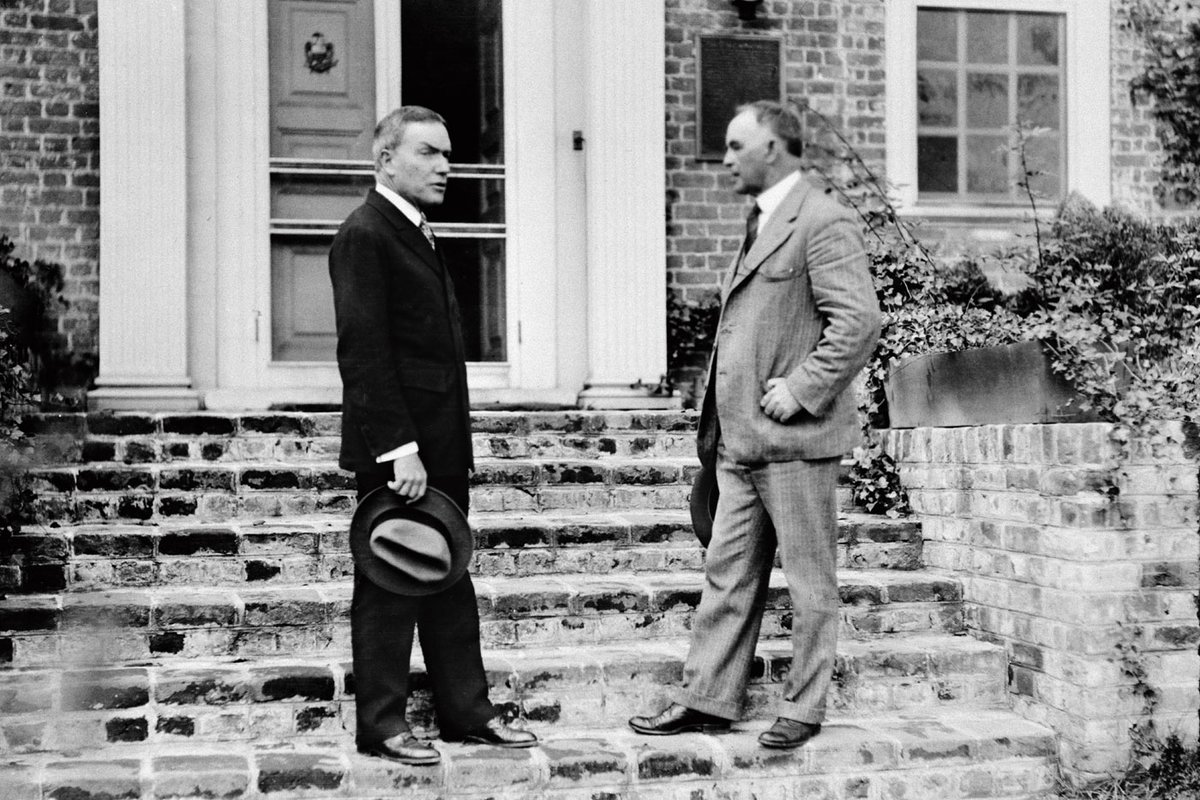
Fortunately for the restoration of Williamsburg, Goodwin was also courting John D. Rockefeller Jr. Goodwin first met Rockefeller in February 1924 in New York when Goodwin, who at that time was fundraising for William & Mary, addressed a committee raising funds for a Phi Beta Kappa (PBK) memorial hall in Williamsburg. Rockefeller, who chaired that committee, was a member of PBK, which had been founded by William & Mary students in 1776. In his discussions with Rockefeller about the hall, Goodwin invited him to visit Williamsburg. Rockefeller took up the offer in March 1926, accompanied by his wife, Abby Aldrich Rockefeller, and three of their sons.
The main purpose of Rockefeller’s March trip was to visit Hampton Normal and Agricultural Institute, a college for African Americans to which Rockefeller had long contributed. Now Hampton University, the school is about 30 miles from Williamsburg. When the Rockefellers arrived in town, Goodwin gave them a tour.
During the visit, Rockefeller asked whether there was any plan to preserve the town’s colonial buildings. Sensing the timing was not right and exhibiting remarkable restraint, Goodwin did not then ask Rockefeller for money. “I found it exceedingly hard at the time not to burst forth in the presence of Mr. Rockefeller into unfolding my cherished dream,” Goodwin later wrote.
On Nov. 27, Rockefeller returned to Williamsburg for the dedication of Phi Beta Kappa Hall, and he and Goodwin again toured the town. This time Goodwin revealed his dream of restoring the colonial capital. Rockefeller was intrigued. He agreed to pay for an architect to make some sketches. Ever cautious, Rockefeller made clear that was the extent of his commitment, but two days later he wrote Goodwin asking for more details about colonial properties and what it might cost to buy them. Goodwin must have been especially thrilled to read that Rockefeller felt that “the acquisition of isolated houses ... could not be of the largest value” and that Rockefeller would only be interested if “some complete thing could be done.”
Just a few days later, on Dec. 7, Rockefeller authorized Goodwin to buy a house built in 1752-53 for Philip Ludwell and later lived in by one of his daughters, Lucy Ludwell Paradise. The house, which came to be called the Ludwell-Paradise House, was the first property purchased as part of Williamsburg’s restoration.
Rockefeller originally estimated the project would cost about $5 million. He would eventually spend about $68 million of his own money on Williamsburg, and other family members would contribute about $25 million more. Rockefeller once jokingly referred to his tours of the town with Goodwin: “I’d heard of people being taken for a ride. Dr. Goodwin took me for a walk!”
What motivated Rockefeller to give millions to restore Williamsburg? Cynical historians have attributed Rockefeller’s philanthropy, in Williamsburg and elsewhere, to a desire to improve the robber-baron image of his father. John D. Rockefeller Jr. unlike Henry Ford, had mixed feelings about his family’s role in the Industrial Revoluton. Williamsburg offered Rockefeller a chance to escape from the stresses of industry to what seemed a simpler and more peaceful world. Rockefeller was also genuinely interested in architecture, and he enjoyed studying the plans for Rockefeller Center in New York as well as for Williamsburg. He immersed himself in the details of both. At one point, when researchers learned that a partly reconstructed house was 6 feet from its 18th-century location, Rockefeller insisted it be moved regardless of the cost. He told his advisor and biographer Raymond Fosdick, “No scholar must ever be able to come to us and say we have made a mistake."
Adapted from That the Future May Learn From the Past: The First 100 Years of Colonial Williamsburg, available at shop.colonialwilliamsburg.com.
Phi Beta Kappa: The Beginning
The histories of Colonial Williamsburg and Phi Beta Kappa were intertwined long before the Rev. Dr. W.A.R. Goodwin met John D. Rockefeller Jr. at a 1924 fundraiser for a Phi Beta Kappa (PBK) hall on the William & Mary campus. According to PBK’s website, the first meeting of PBK, on Dec. 5, 1776, took place in the Apollo Room of the Raleigh Tavern. Not all historians agree about that. Richard N. Current, in his history of the society, argued that a secret society — as PBK originally was — was likely to meet in some room at William & Mary rather than at a place as public as the Raleigh. But Current may not have appreciated that 18th-century taverns were often venues for private dinners, balls and receptions. Whatever the exact location of the first meeting, there is no doubt it took place in Williamsburg. Two hundred fifty years later, PBK is one of the nation’s most prestigious academic honor societies with chapters at nearly 300 colleges and universities.
More from this Issue